Introduction and Historical Context
When Sega Rally Championship debuted in arcades in 1994, it didn't just join the racing genre—it revolutionized it. Following the massive success of Daytona USA, Sega's arcade department aimed to capture the gritty, high-octane spirit of off-road rally motorsport. Sega Rally Championship stood out by introducing dynamic surface physics, making it one of the earliest racing games where driving on tarmac, gravel, or mud distinctively altered handling and momentum.
Developer and Innovation
The title was developed by the legendary Sega AM3 division under the direction of Kenji Sasaki and co-created by Tetsuya Mizuguchi. Driven by the groundbreaking Sega Model 2 arcade hardware, the team leveraged 3D texture-mapped graphics to deliver fluid 60-frames-per-second gameplay that captivated arcade goers worldwide. AM3's meticulous attention to car handling and track layout created an unprecedented balance between realistic simulation and fast-paced arcade action.
Story and Narrative
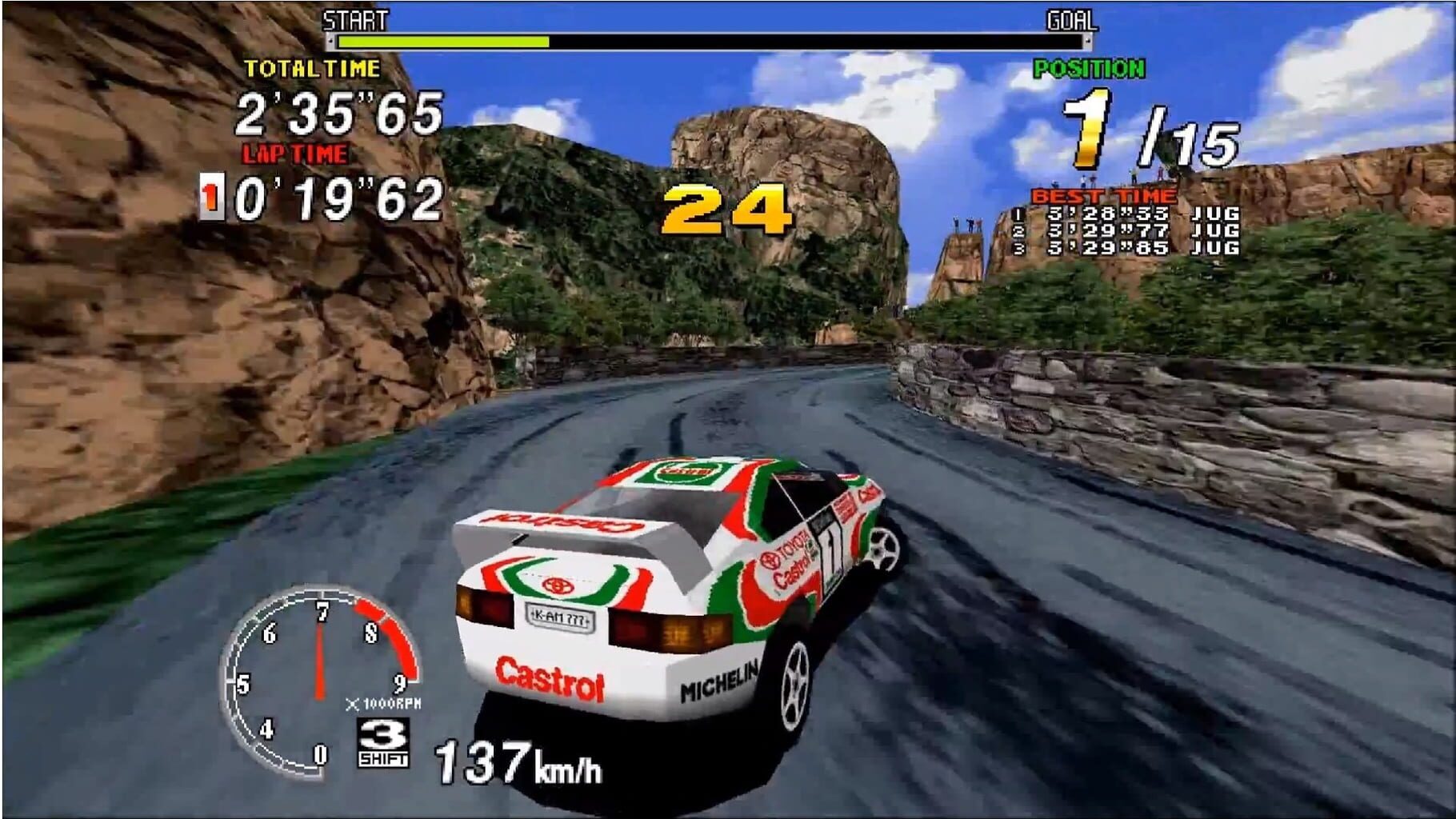
In true 1990s arcade tradition, Sega Rally Championship abandons elaborate narratives in favor of pure motorsport adrenaline. Players step into the shoes of a world-class rally driver competing in the Championship mode, racing against time and aggressive AI opponents across four escalating tracks: Desert, Forest, Mountain, and the secret Riviera stage. The drive for glory is straightforward—reach the checkpoints, climb from 15th position to 1st, and claim the world championship trophy.
Iconic Licensed Vehicles
The game featured officially licensed rally legends of the era:
- Toyota Celica GT-Four (ST205): Balanced control and excellent acceleration.
- Lancia Delta HF Integrale: Superior traction and sharp cornering responsiveness.
- Lancia Stratos HF: A secret unlockable super-car known for high top speed and challenging drift mechanics.
Graphics, Sound, and Visual Appeal
Visually, Sega Rally Championship was a masterpiece in 1994. The 3D environments featured rich foliage, dynamic shadows, and detailed vehicle models that reflected lighting realistically. Complementing the visual marvel was an unforgettable audio package composed by Takenobu Mitsuyoshi and Konoma. From the engine roars and tire screeches to the iconic voice co-driver callouts ("Easy right, over jump!") and the immortal "Game Over, Yeah!" jingle, the audio design remains legendary.
Playable Platforms
Sega Rally Championship made its mark across several home platforms over the years:
- Arcade (1994): The original Model 2 cabinet featuring force-feedback steering and twin-seater setups.
- Sega Saturn (1995): Widely considered one of the greatest arcade-to-console ports in gaming history, maintaining smooth 30fps gameplay despite hardware limitations.
- PC / Windows (1997): Enhanced resolution options and network multiplayer capabilities.
- Game Boy Advance (2002): A reimagined isometric/pseudo-3D handheld version.
- PlayStation 2 (2006): Released as an accurate arcade-perfect port bundled on a bonus disc with Sega Rally 2006 in Japan.
Final Recommendation
Sega Rally Championship (1994) is a timeless masterpiece that defined a genre and remains endlessly fun to play today. Its tight drift mechanics, flawless track design, and infectious presentation make it an essential play for retro enthusiasts, racing game fans, and gaming historians alike. Whether played on original arcade hardware or via the famed Sega Saturn port, it receives an enthusiastic 5 out of 5 stars.